
The web was invented in 1989 by Tim Berners-Lee at CERN. Most of what gets called innovation is just the same problems being solved again, with better tooling.
The document model
In the beginning, there was HTML. A file on a server. A browser that rendered it. CSS arrived shortly after and separated structure from presentation. JavaScript added behaviour. Three languages, three responsibilities — a separation of concerns that still holds today.
No build step, no framework, no deployment pipeline. You uploaded a file and it worked. This is still the most reliable deployment model ever invented.

The document model era
The PHP decade
Dynamic content changed everything. PHP let the server build HTML on the fly — user data, database queries, business logic, all rendered server-side before the browser saw a single byte. It took over the web almost entirely. WordPress still powers roughly 40% of the internet.
Then Ajax arrived and the browser stopped reloading on every interaction. Gmail and Google Maps showed what the web could actually be. Node.js finished the shift — JavaScript on the server meant one language across the full stack, and PHP's dominance as the server-side language of choice was effectively over. The full-stack developer became a realistic job title.
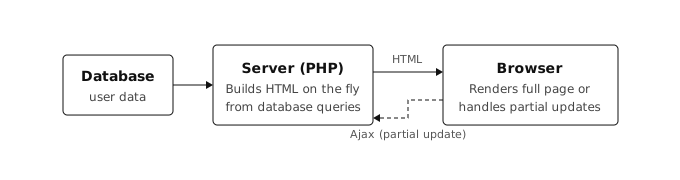
The PHP decade
Everything is a component
React introduced a component model in 2013 that changed how people thought about UI entirely. Angular, Vue and Svelte followed with their own takes. The single-page application became the default architecture — the server delivered an empty HTML shell, JavaScript took over and rendered everything in the browser.
The Jamstack movement extended this further: pre-built static files, a CDN, a headless CMS. Fast, scalable, deployable anywhere. It peaked, solved real problems and made static sites a serious option again.
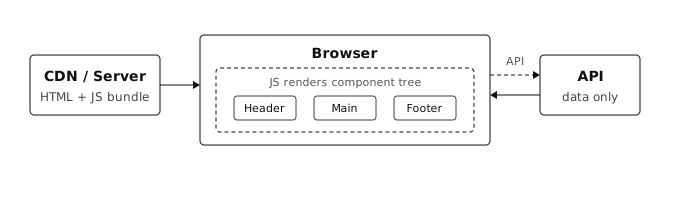
The component era
The SSR renaissance
The pendulum is swinging back. Next.js brought server-side rendering back into fashion, this time with the component model intact. The irony is that the most robust applications being built today look a lot like what was being built in the late nineties — content delivered from a server, JavaScript used where it earns its place, HTML doing most of the work.
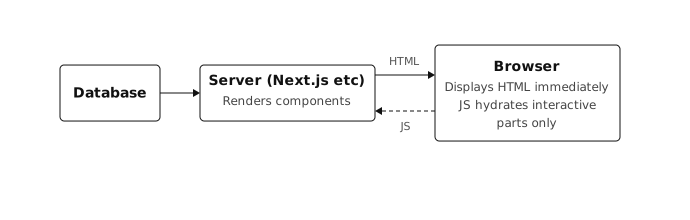
The return of the server
The tooling is dramatically better. The fundamentals are the same.
The question that separated good developers from fast ones was always the same: do you understand what the tool is doing, or just that it's working? Every major shift in web development produced a wave of developers who could use the new thing without understanding the old one.
That gap is still there. It just moves faster now.