

A VPN is an encrypted tunnel between your device and a server that then talks to the internet on your behalf.
Almost every VPN people know about sells privacy. NordVPN, Proton VPN or a self-hosted OpenVPN server on a cheap VPS — different products, same shape. Your traffic exits somewhere else, the site sees that address instead of yours and the point is to appear somewhere you aren't.
There's a second kind of VPN that solves the opposite problem: not hiding where you are, but reaching machines that were never public to begin with. A server at home, a NAS, a laptop sitting on hotel Wi-Fi. Tailscale is the best known example of that kind.

Tailscale VPN
Under the hood
WireGuard already solved the hard part. It's a small, fast VPN protocol that's been in the Linux kernel since 5.6. What it deliberately doesn't solve is everything around it — you generate keypairs by hand, copy public keys onto every peer, keep the allowed address list in sync and make sure at least one end has a reachable IP and an open port. Fine for three servers, hopeless for ten devices that change networks daily.
Tailscale is the wrapper around that problem, written in Go. You log in with an identity provider and a coordination server distributes public keys and current addresses to your devices, which then use that to punch through NAT and build WireGuard tunnels directly to each other.
Directly is the word doing the work. A traditional VPN is hub and spoke: every client dials the same concentrator and everything flows through it, so two machines in the same room talk to each other by sending packets to another continent and back. A mesh drops the middle — every device holds a connection to every other device, and traffic between two of them goes between those two and nowhere else.
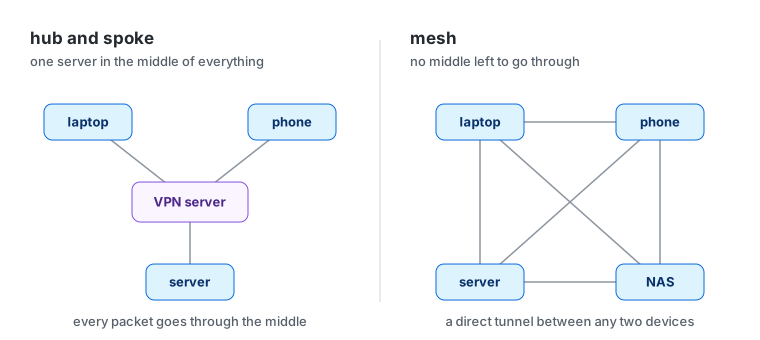
Hub and spoke vs mesh
The result is a private network — a tailnet — where every device gets a stable address in the 100.64.0.0/10 range and a name that resolves everywhere. Same address at home, on mobile data, on someone else's Wi-Fi.
My setup
There isn't much of one, which is the interesting part. Every device got the app from its respective store, logged in and joined. Nothing went through a terminal, no config file, no keys copied anywhere.
The exit node runs on a machine at home — one setting in the app, one approval in the admin console. It works, but it also means that machine has to stay powered on whenever I want to route through home, which is, to be honest, a weird reason to leave a desktop running. A Raspberry Pi is the obvious replacement: always on, draws almost nothing, does nothing else.
The one thing worth doing in the admin console is the policy file. By default every device on a tailnet can reach every other device and I don't need that — I need the exit node and nothing else:
{
  "acls": [
    {
      "action": "accept",
      "src": ["autogroup:member"],
      "dst": ["autogroup:internet:*"]
    },
    {
      "action": "accept",
      "src": ["autogroup:member"],
      "dst": ["autogroup:self:*"]
    }
  ]
}
The café problem
The scenario everyone reaches for is checking your bank on public Wi-Fi, and the honest answer is that less is at risk there than the marketing suggests. HTTPS is everywhere and nobody in that café is reading your banking session out of the air.
The narrower thing you do get is worth having. Your device stops sharing a local segment with every other machine in the room, and the bank sees the same address it always sees instead of one in whatever city you happen to be in. That second one is what matters in practice — sensitive services read a new IP as a signal, and the response is extra verification, a blocked login, sometimes a locked account while you're travelling.
So: not anonymity. The opposite of it. The IP is always mine, deliberately.
Killing the middlemen
The old way of reaching something at home is to open a port on the router, forward it to an internal address and hope nothing else finds it — a service left open to every scanner on the internet whether or not it was ever meant to be found. On a tailnet there's nothing to expose in the first place. The service listens on the machine, the machine is in the network, every other device reaches it by name.
When the point is the opposite — a client needs to see today's build, a webhook provider needs a URL that resolves — the usual answer is ngrok. Funnel is the same idea on a network that's already there. HTTPS certificates get switched on in the admin console and the attribute goes in the policy file:
"nodeAttrs": [
  {
    "target": ["autogroup:member"],
    "attr": ["funnel"]
  }
]
Then tailscale funnel 3000 puts a dev server on the internet at the machine's own name, valid certificate, nothing forwarded on the router. That name is the same every time, which is what the free ngrok tier doesn't give you: a webhook URL you configure once. It stays up as long as the command is running and anything arriving through it is unauthenticated by definition — inside the tailnet identity comes with the network, here it's the app's problem.
Taildrop might be the best of the small features. Send Files gets enabled in the admin console, macOS wants the client allowed under System Settings > General > Login Items & Extensions > Sharing, and after that it's an entry in the share menu like any other — right click on the desktop, Share on the phone, pick Tailscale, pick the device. macOS to Linux to a phone, none of them caring what the other one is: once the devices are on one network, the workaround stops being necessary instead of getting easier.
In short
One app on every device and a short policy file replaced a port forward, a dynamic DNS client and a file sharing service. Not because any of that was hard, but because it stopped being a problem worth having.